

The strength of the spiral tube is generally higher than that of the straight seam welded pipe. It can use a welded pipe with a larger diameter of the billet material, and can also use the same width to produce a tube with different welded pipes with different billet production pipes. However, compared with the same length of the same length, the length of the weld is increased by 30 ~ 100%, and the production speed is lower. Therefore, most of the smaller -caliber welded pipes are welded with straight seams, and most of the large -caliber welded pipes are mostly spiral welded. After the large -diameter spiral steel pipe manufacturer, the two edges of the spiral steel pipe billet were heated to the welding temperature. Under the squeezing roller, the common metal grains penetrated and crystallized, and finally a firm welded joint.
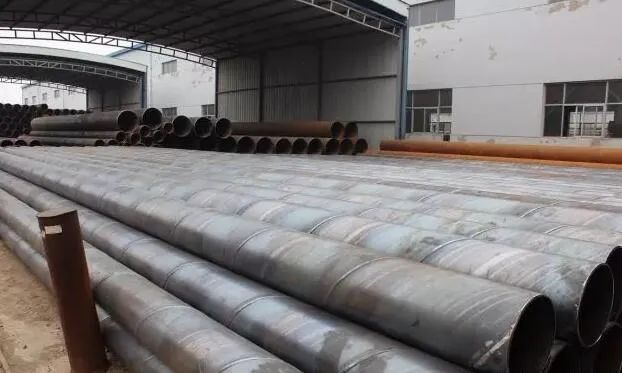
The spiral steel pipe is welded with double -sided arcs. Inner welds and outer welds have a height after welding. The height of the welding residue of the spiral steel pipe is also stipulated by the standard. What is the standard range of the welding residual height? In fact, the requirements of standard spiral steel pipes and national standard spiral steel pipes on welded residual heights are the same. The wall thickness is less than or equal to 13 mm spiral steel pipes. The remaining height of the inner weld and the outer weld must not exceed 3.5 mm, and the wall thickness is greater than 13 mm. The remaining height must not exceed 4.5 mm.
How to measure the residual height of the welded seams of the spiral steel pipe? First of all, we should prepare a weld to check the ruler, visually check the formation of the weld, select a representative part, and use the weld to check the ruler. The measurement direction should be parallel to the axis of the spiral steel pipe. Spiral steel pipe manufacturers usually control the height of welded seams between 2 mm and 2.5 mm, because the spiral steel pipe welds produced in this way are relatively beautiful.